Monday, February 27, 2012

#4 Rules of Civility

By Amor Towles

There seems to be a lot of books out there that basically tell you what book the book you are reading is a retelling of.  I fail to understand the purposes behind this in many situations.  (Yes, I get that your YA novel is a retelling of Romeo and Juliet.  Your main characters don't have to be studying it and referencing it through out the book.)  Some books do it in an annoying way, even well written ones, but  Rules of Civility is an exception to this.  Yes, there are plenty of references to other works of literature, but they aren't used as an explanation of the plot, they are used to drive the plot.  I've never been so satisfied with the weaving of other works into another story.  The characters were driven by ideas that they read about.  The references didn't guide the reader, they were there to show you the road signs that were important to the characters decisions.  Towles is able to reference Walden in explaining the change of heart of one of the main characters.  He uses George Washington's Rules of Civility and Decent Behavior as the back drop for the entire book, making its introduction early on, and its importance came into focus not at the end, but when the characters needed it.
Beyond the smaller references, Rules of Civility is basically a retelling of The Great Gatsby, which I have yet to read, but I know the basic plot.  Rules of Civility is about young girl living in excitement of Manhattan at the end of the 1930's.  1938 is a significant year in her life, when so many people that she holds affinity for entered and left her life.
I hope that when my daughters are in their early twenties that I'll remember this little gem.  It's bound to help at a time when relationships are quickly forged and life has a way of whisking you away to something else, no matter how much you try to stay.

Sunday, February 26, 2012

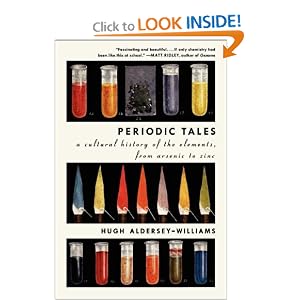
#3 Periodic Tales

Periodic Tales is about the history of the discovery of the elements, and Hugh Aldersey-Williams's attempt to observe that history.
Williams* chronicles his travels in search of samples of the elements, to the locations of the discovery of elements, and to the mines of Ytterby, where about 10% of the naturally occurring elements were extracted from the earth and later isolated by scientists employed by the mines.  He also tries to  recreate the chemical experiments that led to the isolation of some of the elements.  (My children were especially amused that the discovery of phosphorous involved Hennig Brand trying to figure out what was in his urine.)
Reading about Williams's excursions made me want to take a few trips myself.  It is amazing how much the properties of the elements have played into human history.  It seems that to Williams, visiting the laboratories where the elements isolated and experimented with is as important as visiting Independence Hall or the Berlin Wall to the human experience.  I think I whole heartily agree.

*I'm not completely sure what the protocol is for hyphenated names, so I just went with the last one.

Thursday, February 16, 2012

All About Spelling

I've been getting a lot of questions about homeschooling, what we use how my days go, etc.  This is a the first of several posts that I'll be writing about it, then I can direct people to my blog to answer their questions.


All About Spelling is our spelling curriculum.  What I like most about it is that it teaches the rules for spelling.  Surprisingly enough there are rules to spelling in English.  There are many words that the rules don't apply to, either because of established traditional spellings, or because of changes in language after the spelling rules were established.  Then there are the pesky words from foreign languages that we are so fond of.  English has way more words than German because of this.  But, for the elementary set, it's pretty easy to teach the basics and a few of the exceptions.
I chose this curriculum because other spelling curricula focused mostly on memorizing the way words are spelled.  This is how I was taught to spell, and I HATED it.  I never did well on spelling tests.  Now, I'm a good speller because I write and read a lot and because every time I misspell a word, a little red line shows up underneath it (thank you spell check).  I wanted a spelling program that did something different than giving a list of words to memorize.  I prefer to see a logic to something, that's my learning and my teaching style.  The children seem to like it better too.  We briefly tried another spelling curriculum and of course they had a more traditional spelling experience in school.  The are responding much better to All About Spelling.
If you aren't homeschooling, but have a struggling speller, I would recommend getting this curriculum to help them out.  It may not coincide with what they are doing at school, but it will help them in the long run.
The All About Spelling website has sample lessons and shows pictures of the materials.
With Bailey and Abigail, we rarely use the tiles, because they are good spellers, so it is more like we are reviewing the material.  With Lucy I am sure that I will use the tiles more like the program recommends.  The nice thing about this program is that it can easily be tailored to your needs.